Daniel Simkin, IET Library Deputy Library Manager
In this blog we will look at the development of nuclear power in the USSR via two pamphlets in the IET library collections. These are First in the World! An Illustrated Description of the Soviet Atomic Electricity Station (Soviet News, 1956) and Chernobyl (Central Electricity Generating Board, 1986). I will be using the spellings Chernobyl and Kiev, rather than Chornobyl and Kyiv, as this is how they are presented in the second pamphlet.
First in the World! An Illustrated Description of the Soviet Atomic Electricity Station (1956)
Our first pamphlet was published as Soviet News Booklet no. 2 in London in 1956. Soviet News was a publication of the embassy of the USSR, at that time based in Rosary Gardens in South Kensington. First published in 1941 and continuing until the collapse of the USSR its aim was to inform readers of developments in the USSR and to foster relations between Britain and the USSR. A similar paper, the British Ally, was published in Russian by the UK Government and distributed there. When asked in Parliament about the paper the Labour MP Wilfred Burke is recorded in Hansard as stating “paper is made available to the Soviet Embassy in London for printing 12,000 copies per issue of the daily Soviet News and 75,000 copies per issue of Soviet Weekly. The editor enjoys the same freedom as the editor of any British paper in this country.”
Tsarist Russia in the early 20th Century was considered far behind other European countries in terms of development with the economy still being based largely on agriculture. Serfdom was abolished in 1861, but this left peasants with limited land and in a cycle of debt that meant rural poverty was still acute and widespread. Discontent with the ruling elites and their persecution of the general population led to the revolutions of 1905 and 1917.
After the February revolution of 1917, in October the Bolsheviks, led by Lenin and Trotsky, overthrew the unpopular and weak provisional government and established the Russian Soviet Federative Socialist Republic, the first communist state, becoming the USSR in 1922. When the Bolsheviks took power the country was still one based primarily on a dysfunctional agrarian system, but from 1929 embarked on a rapid process of industrialization that turned the USSR into a leading European power that would be instrumental in the defeat of Nazi Germany and then ultimately a world superpower.
This is illustrated in a discussion between English science fiction writer H. G. Wells and Lenin that took place in 1921. Wells was shocked by the depravation he saw in both the town and the countryside remarking “by 1921 Russia presented an unprecedented picture of modern civilization in a state of complete decay.” Lenin laid out his plans for the future of Russia powered by electricity telling Wells “come back and see what we have done in Russia in ten years time.”
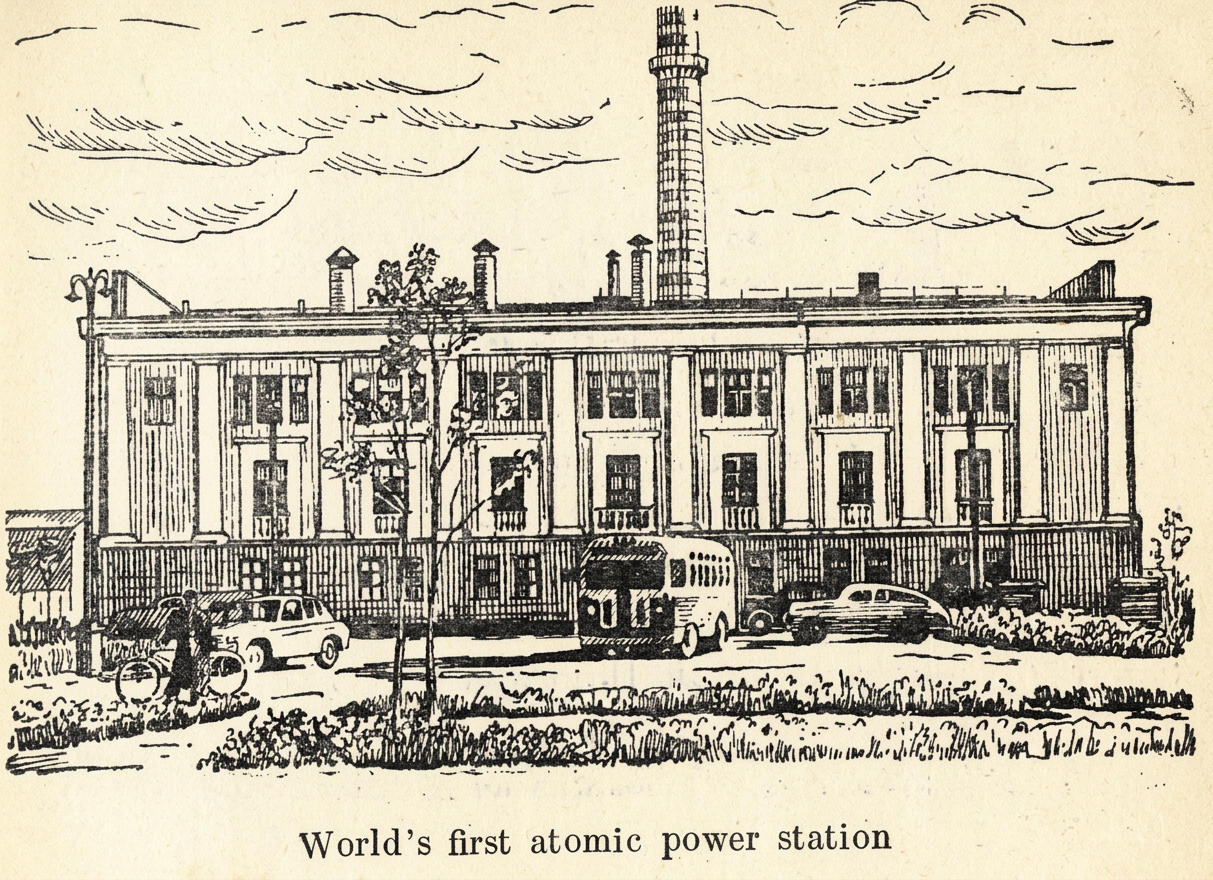
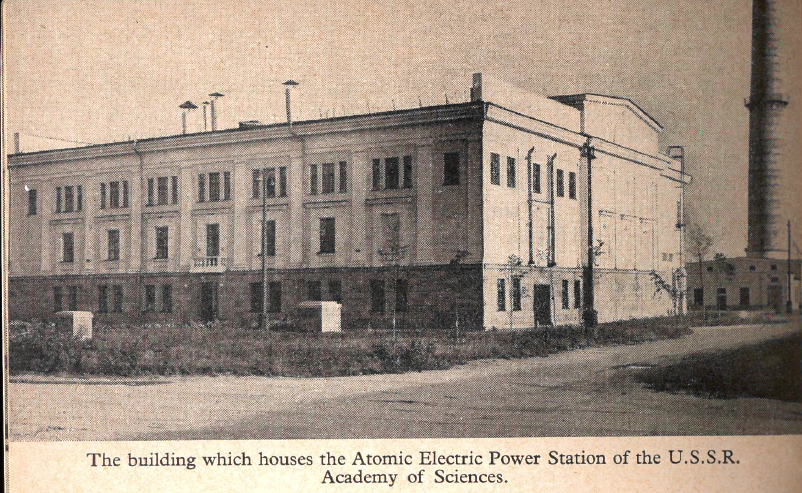
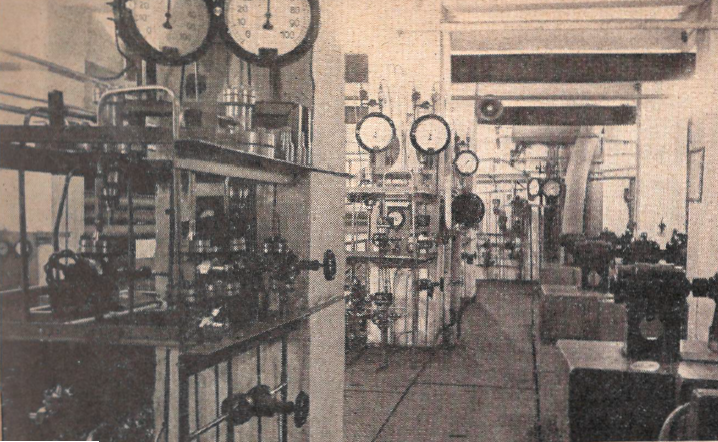
Our first pamphlet notes that the world’s first gird connected nuclear power plant was commissioned in the USSR on 27 June 1954 with a power of 5,000kw producing in its first year about 15 million kwh of electric power. Multiple layers of pig-iron and graphite covered the furnace with the reactor enclosed in a sealed steel jacket on a concrete foundation. Fuel tubes with charges of uranium are hung around the walls and are inactive until they are lowered into the reactor. The heat from the uranium produces steam that drives the turbine and the electric generator. This facility at Obninsk would be decommissioned in 2002.
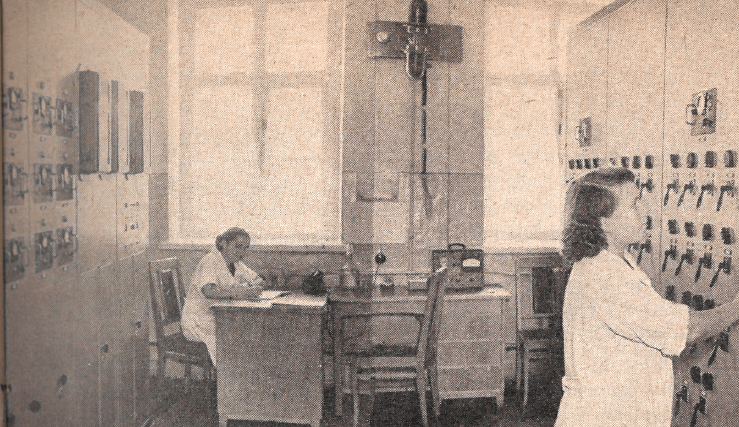
Several safety measures are described in the pamphlet ranging from monitoring instruments in the control room as well as every worker in the facility carrying an electric dose-meter about the size of a pen. They also carried a small photographic plate with film sensitive to radioactivity. Every four days these would be developed to determine the dose of radiation received by a worker during their shift. The writer of the pamphlet notes that “all the equipment of the power plant works with infallible precision. No serious disturbance has happened there since it went into operation – a credit to the Soviet scientists and engineers, to Soviet science and engineering skill.”
The pamphlet ends on a hopeful note suggesting “the first Soviet atomic power plant for the production of electricity has shown in practice that harnessed to useful purposes atomic energy opens before mankind unprecedented prospects for peaceful labour, prosperity and happiness.” This is an interesting note to end on considering that the USSR had begun testing nuclear weapons since 1949, accelerating development of these in response to the USA’s bombing of Hiroshima and Nagasaki. Five years after the publication of this pamphlet Nikita Khrushchev and Fidel Castro would agree to place Soviet nuclear weapons on Cuba in response to the USA’s aggression against Cuba, culminating in the failed Bay of Pigs invasion, and the USA placing their nuclear weapons in Italy and Turkey, within range of Moscow. This would become known as the Cuban Missile Crisis and the closest the Cold War came to a nuclear conflict.
Chernobyl (1986)
Our second pamphlet was produced in response to the accident at the Chernobyl nuclear power station by the Central Electricity Generating Board (CEGB). The CEGB was the government body responsible for electricity generation and transmission in England and Wales from 1958 until privatisation of the electricity industry in the 1990s when the CEGB was broken up into four companies, separating generation from transmission.
This pamphlet was produced to assuage fears that a similar accident to Chernobyl could occur in UK nuclear power stations. As well as being the year of the Chernobyl incident 1986 was a pivotal year in the history of nuclear weapons as well as power. Global stocks of nuclear weapons reached their peak in this year with the USA and the USSR possessing most of them. However, it also marked a year of hope for a world free of nuclear weapons as Mikhail Gorbachev and Ronald Reagan met in Reykjavik for a summit to drastically reduce their number with Gorbachev proposing a total elimination of nuclear weapons by 1995. The talks collapsed but did lead to the Intermediate-Range Nuclear Forces Treaty, an arms control treaty between the USA and the USSR. The USA would withdraw from the treaty in 2019 and Russia announced that it no longer considered the treaty binding in 2025.
The pamphlet begins describing how on 28 April 1986 background levels of radiation in Sweden were discovered to be higher than normal with no local reason for this. The USSR then announced that an accident had occurred on 26 April in the number 4 reactor at the Chernobyl nuclear plant, which was based in Ukraine, about 60 miles from Kiev, and 700 miles from Sweden where the high radiation readings were taken. The nature of the accident is reported at the time as involving a sudden surge of power in the reactor causing a hydrogen explosion followed by a fire in the reactor building.
In the pamphlet the CEGB note there were nearly 400 nuclear power reactors in operation at the time in 26 countries with the CEGB operating 12 of them. The type of reactor used in Chernobyl was an RBMK reactor which is a boiling water pressure-tube graphite-moderated reactor and a unique Soviet design. The reactor type used in the UK electricity industry also used a graphite moderator, but operating at a much lower temperature than the RMBK design. The higher temperature in the Soviet reactor and the proximity of the graphite to water, used as a coolant, was regarded by the CEGB as posing much greater safety problems. The pamphlet notes that in previous accidents radioactivity had been largely contained, such as that at the Three Mile Island power station in the USA in 1979, but at Chernobyl large quantities of radioactivity escaped.
The CEGB was critical of the decision of the USSR to not disclose details of the accident and as such failing to comply with international agreements to inform neighbouring countries as soon as possible after the accident. The pamphlet argues that “this would certainly not be the case if a similar accident happened in the Western World”. As well as reflecting the position of the UK in the ongoing Cold War this had not historically been true as the British government had supressed reporting on the Windscale Fire in 1957, the worst nuclear accident in the UK’s history, for fear of damaging nuclear relations between the UK and the USA.
The accident at Chernobyl would have wide ranging ramifications not least for the future of the USSR itself and changing attitudes to freedom and transparency. Serhii Plokhy who wrote Chernobyl: History of a Tragedy argues that:
“The first mass movement in the Soviet Union gathered around ecological issues, and Chernobyl was responsible for that. That was permissible under glasnost; Chernobyl and glasnost are one and the same. I’m not saying there would have been no glasnost without Chernobyl, but glasnost happened when it happened and how it happened because of Chernobyl. It exposed the culture of secrecy and it hit everybody. It didn’t just affect non-party members; it affected party members, the police, the KGB, everybody felt threatened and it suddenly became a legitimate concern of the entire society. Before that, there had been very few concerns that the entire society shared.”
References
IET Library and Archives resources
Chernobyl (Central Electricity Generating Board, 1986). Collection reference: 621.039 CEN
First in the World! An Illustrated Description of the Soviet Atomic Electricity Station (Soviet News, 1956). Collection reference: 621.311 SOV
Soviet Electric Power: Development and Prospects, A Markin (Foreign Languages Publishing House, 1956). Collection reference: 93:621.311 MAR
The Chernobyl accident, Lord Marshall, 1986 Collection reference: UK0108 NAEST 253/10/20
Chernobyl, John G Collier and L Myrddin Davies, 1986. Collection reference: UK0108 NAEST 253/10/23
External sources
Chernobyl: History of a Tragedy, Serhii Plokhy (Allen Lane, 2018).
The Shortest History of the Soviet Union, Sheila Fitzpatrick (Columbia University Press, 2022).
A People’s History of the Russian Revolution, Neil Faulkner (Pluto Press, 2017)
Russia: A 1,000-Year Chronicle of the Wild East, Martin Sixsmith (BBC Books, 2012)
The Soviet Century, Moshe Lewin (Verso Books, 2017)
 IET Archives blog
Leave a comment