By Daniel Belteki, Graeme Gooday and Anne Locker
Introduction
What was so special about June 1926? It wasn’t just that Britain was emerging from the extraordinary near paralysis of a General Strike the previous month, nor that a Conservative government was trying – unprecedentedly – to legislate for the UK to have a National Grid for mass electricity supply. This was also the moment that saw the arrival of a brand-new magazine: The Electrical Age for Women. Under a variety of names, this stylish publication ran for another six decades, with its young parent organisation, the Electrical Association for Women vigorously campaigning for the benefits of electricity in homes and businesses. That magazine is available for all to view (see link above) as a route into a past world that many now will find surprising and fascinating for its stories of women’s skilled work in technology.
To mark the centenary of that magazine’s launch one hundred years ago, we are pleased to share new digital resources to help you navigate the millions of words available. You will find here the first full name index of the many women – and some men – who appeared in the pages of The Electrical Age. You will also find here a complete listing of locations mentioned in those pages to help you to research your area’s history of electricity supply, consumption, and much more besides. As these resources are still under development using AI-guided digital tools– as explained further below – we warmly encourage readers to send us suggestions for corrections and improvements.
Obviously, we draw your attention to the very first issue in June 1926 that opens rather dramatically on its first page with the first EAW President, the Conservative MP Nancy, Lady Astor offering feminist encouragement to women to enter all areas of industry.

At a time that the E.A.W. needed finances to sustain its operation, you can also see in this issue much advertising from industry sponsors. Advertisements from the Glasgow Corporation Electricity Department and the British Electrical Development Association, encouraged demand for electricity from the Electrical Age for Women’s readers: after all, women were key agents in making decisions about whether to electrify the home.
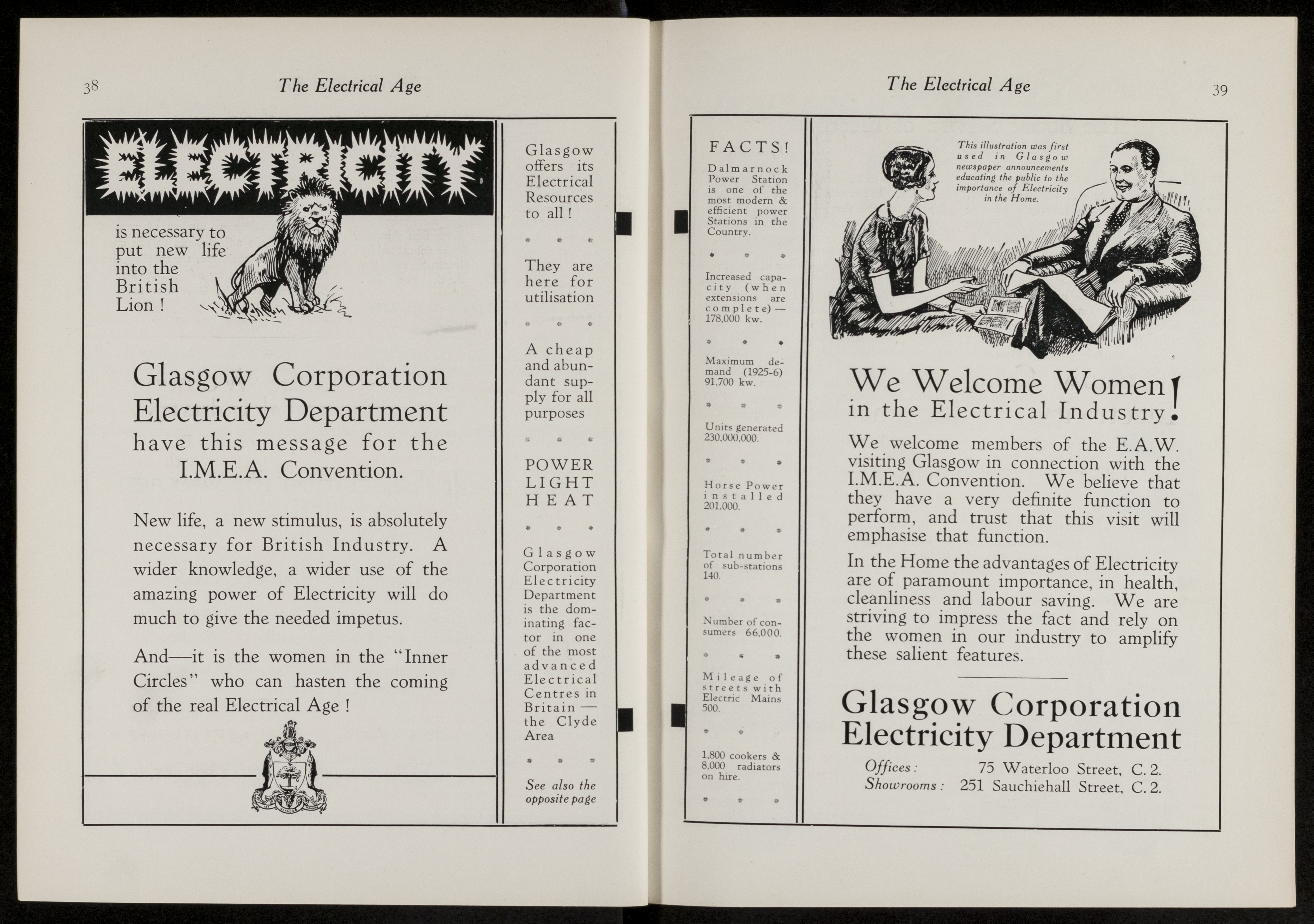
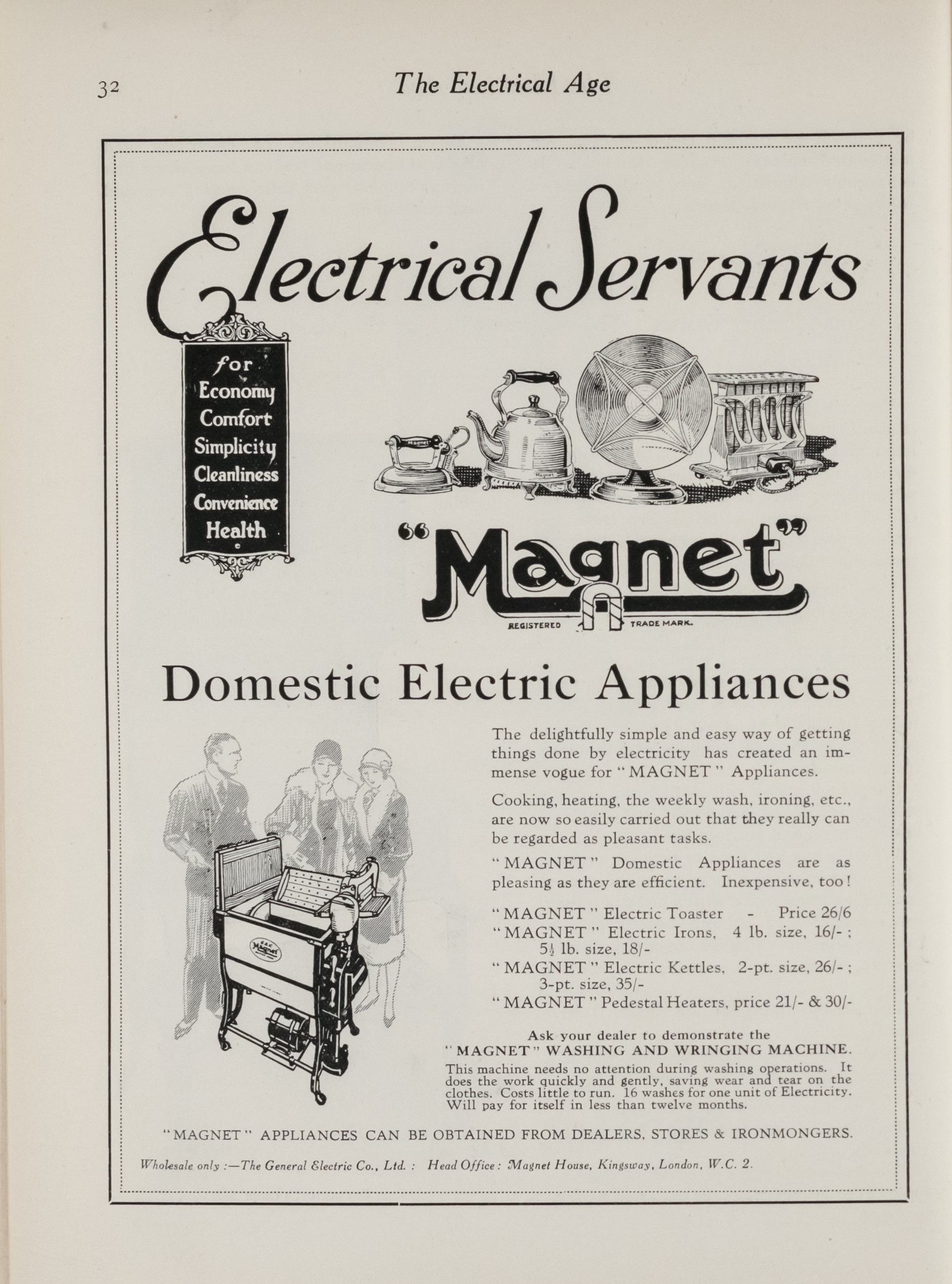
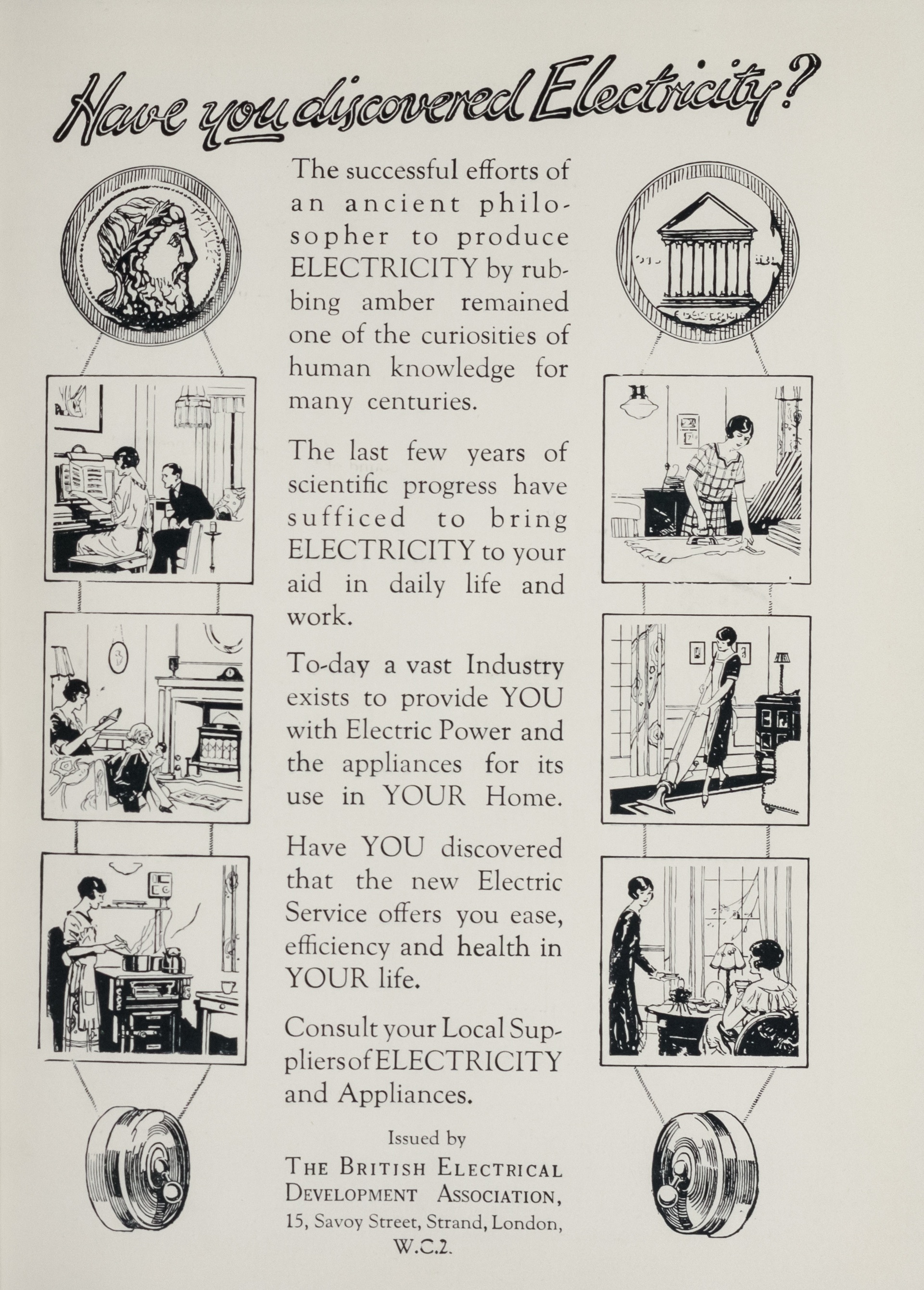
The theme of industry sponsorship runs right through the EAW’s history until it closed in 1986, at a time when domestic electricity was available across pretty much all of Britain. But what else can be learned of the women who featured in the pages of the Electrical Age? Many of these women have not been previously researched or easily identified, beyond the spouses whose surnames they adopted. To understand the broader context, let’s consider how the IET Archives went about this project.
IET resources on women in technology
The IET Archives holds three important collections on the history of women in engineering and technology: the archives of the Women’s Engineering Society (1919-present), the archives of the Electrical Association for Women (1924-1986) and the personal papers of Dame Caroline Haslett (1895-1957), who was actively involved in the founding and success of both organisations. Together these resources cover a crucial 20th century period in the history of technology and gender, from the lives of the first professional women engineers, through the integration of electrical technology into our homes and to challenges still facing the sector today.
In 2019 the Women’s Engineering Society digitised its quarterly journal The Woman Engineer for its centenary celebrations. By hosting its full run from 1919 on the Archives website we understood what a fantastic historical resource a fully accessible institutional journal could be. So when we started planning for the 2024 centenary of the Electrical Association for Women’s founding in 1924, we knew we wanted to digitise its journal, generally known as the Electrical Age, and make it accessible for free online.
While we knew the Electrical Age was a rich and engaging resource, we didn’t fully understand its impact until we opened the digital collection for research. Under Graeme Gooday’s guidance, some Liberal Arts students at the University of Leeds looked at the first two volumes of what was initially The Electrical Age For Women. They wrote blogposts in 2024 on the first regional branches of the EAW and their leading women in the interwar period, producing fresh insights only possible with that resource: this collective post reflects on their process.

In 2025, a further cohort of Leeds students looked at how The Electrical Age (as it was renamed in 1932) covered the Second World War and its aftermath. They explored how electricity was advertised and new homes designed for the post-war era, with active promotion of an American model for domestic electrification. They also explored how Notebook LM could be a very productive AI tool for analysing the PDFs that constituted each volume of The Electrical Age.
Since then, this key resource and digital analytical tools have been a major resource for a recently commenced collaborative PhD project on the life and work of Dame Caroline Haslett, co-founder and Director of the EAW. It has also been used for research into technical careers, architecture, and design.

Next steps
After the digitation of the Electrical Age, we had the benefit of a University of Leeds funded ‘Digital Kickstarter’ project in which Daniel Belteki explored the use of new technology tools, including LLMs, to create finding aids and ensure that the Electrical Age is discoverable by any and all visitors to the IET Archives website. Using these tools to create indexes and data tools has opened up that resource for research into local history, the history of engineering and technology, biographical research, the social history of advertising and consumer behaviour and much more. It has also helped us to understand the potential and limitations of such AI analytical tools, and how we can use it to support and enhance the IET Archives’ work.
Today we are launching two indexes from this project: an index to the people found in the journal, including some of its founder members and past Presidents, and an index to its branches. Along with the other data tools developed by Daniel, these indexes illustrate the importance of champions for electricity in the home, and how quickly the EAW spread its message across the UK and internationally.
Digital tools to analyse the Electrical Age
One of the core aims of digitizing the text of The Electrical Age was to re-process its content into a format that enabled full exploration and computational analysis. To achieve this, we aimed to extract from the thousands of pages of texts (in PDF formats) references to individuals, locations, and the various articles and advertisements within the journals. These important textual ‘entities’ also had to be set up as linked entities. For this purpose, we decided to use a Multimodal Large Language Model: Gemini 3 Flash, then ranked as one of the best performing models, especially in applications to historical collections. Not only was it easy to set up, but its terms and conditions of use were especially favourable.
We utilised Gemini’s enhanced capabilities to identify our chosen entities along with key forms of additional information (and processing). In addition, the multimodal nature of the process also allowed for the enhanced accuracy in detecting which layout element the entities belonged too (e.g. image captions, articles, headings etc.). To aid in the disambiguation between entities with similar names, we adopted standardised naming formats for individuals and locations enhanced by generated brief texts that described their associated relations to their text. In addition, we also extracted whether a person is depicted on a photograph on the page, and what their assumed gender would be.
While each enquiry had its own challenges (e.g. can we ascribe a gender to a person based on simple sentence about them?), it gave us a starting point for engaging with a magazine that was made up of a vast resource of millions of words. Similarly, we had to make a number of decisions and technical set-ups to respect the legal formalities of copyrighted text and images, and basic decisions about what version of the Electrical Age text to use: the OCR captured version (cheaper but losing formatting) or the original scanned page images (maintaining the visual layout, but more expensive). Moreover we knew that different models for AI analysis not only had different biases, but also different levels of accuracy in identifying people and places; so it was necessary to check Gemini’s potential strengths and weaknesses.
Throughout the process, we tracked where Gemini had the optimum potential to be applied to the most effective datafication of The Electrical Age. Gemini’s ability as an enhanced named entity recognition tool was most obviously successful when the same person was referred to with different names within the same article or distinguishing between references to the same person on the same page, but across multiple articles. Similarly, by ingesting contextual information Gemini could generate the name of a location in a format that enabled geocoding links to specific places much easier.
Finally, we found Gemini highly accurate in distinguishing commercial advertisements from journalist articles in searching across the Electrical Age, allowing us to add that distinction as a data classification label. At the same time, our approach obliged us to reflect on what fallible decisions and judgement calls we were implementing e.g. what contextual evidence would Gemini use to decide that two variations of a particular name actually referred to the same person? Would a person in a fictional narrative count as an individual or not? Through questions like these, using Gemini highlighted tricky cases for our questions and the tasks – while sources of frustration – sharpened our reflections on our approach to using AI models in generating the new guidance resources for The Electrical Age.
A user-friendly resource for exploring The Electrical Age
While anyone can search each issue of The Electrical Age here, our AI-enabled project has set up a resource for you to search across the entire sixty year run: Exploring The Electrical Age. Hosted on the free to access platform Github, this provides searchable datasets for articles, locations, and persons.
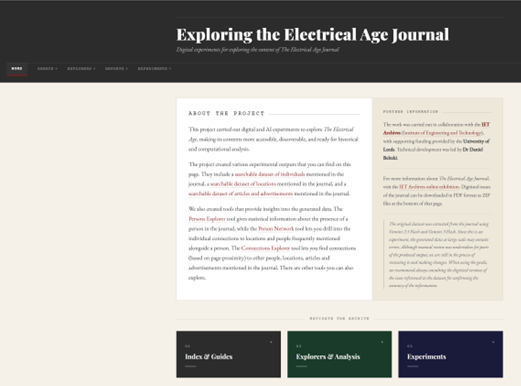
We were struck by the ability of Gemini to identify both fictional (e.g. characters in stories) and real people mentioned in the text, and this is partially preserved in the datasets we have shared there. To indicate the complex nature of a magazine using different writers over six decades, we left many of the names unstandardised since brief references to people with the same surnames were not enough information to justify standardising them. For example, users interested in Caroline Haslett will encounter various formats when searching for ‘Haslett’ in the People dataset. It also offers “explorers” for the location and persons datasets. Within these tools, the user can search for the name of a person or location, which will display additional statistical information about the frequency of a person’s mention in a text, what people are most frequently mentioned with the person, what locations and articles are most often associated with the person, and how such mentions change over time.
Using AI tools
Since we are aware of the potential hallucinations produced by generative AI tools, we always recommend that users check the references to the original pdfs, which is the reason why we preserved the references to the volume, issue, year, and page numbers in the dataset. The dataset is available through a pdf format, but this only includes the names and the page references without the additional information.
An appendix in the guide shows the names of people depicted on photographs along with the references. We also produced a list and a map (and a pdf guide) that show the branches of the Electrical Association for Women that were identified within the texts along with summaries of their histories generated by Gemini.
If you would like to comment on this post, or the resources we have shared in the Github platform please email archives@theiet.org.


Leave a Reply