Guest blog by Dr Patricia Fara, Emeritus Fellow of Clare College, Cambridge
Introduction
According to the film director Jean-Luc Godard, ‘A story should have a beginning, a middle and an end, but not necessarily in that order.’ My own opening scene is set in 1912 Paris, when Marie Curie was in her mid-forties, overwhelmed by radiation sickness and emotional despair. Although she had recently won a second Nobel Prize, for months she had been the victim of savage press campaigns denouncing her for trying to enter an all-male French stronghold, the Academy of Sciences. Public abuse intensified after someone leaked a set of love letters between Curie and an eminent French scientist, Paul Langevin, a friend of her former husband. Journalists camped out on her doorstep while angry mobs hurled rocks at the windows, forcing her to flee for safety with her two small daughters.
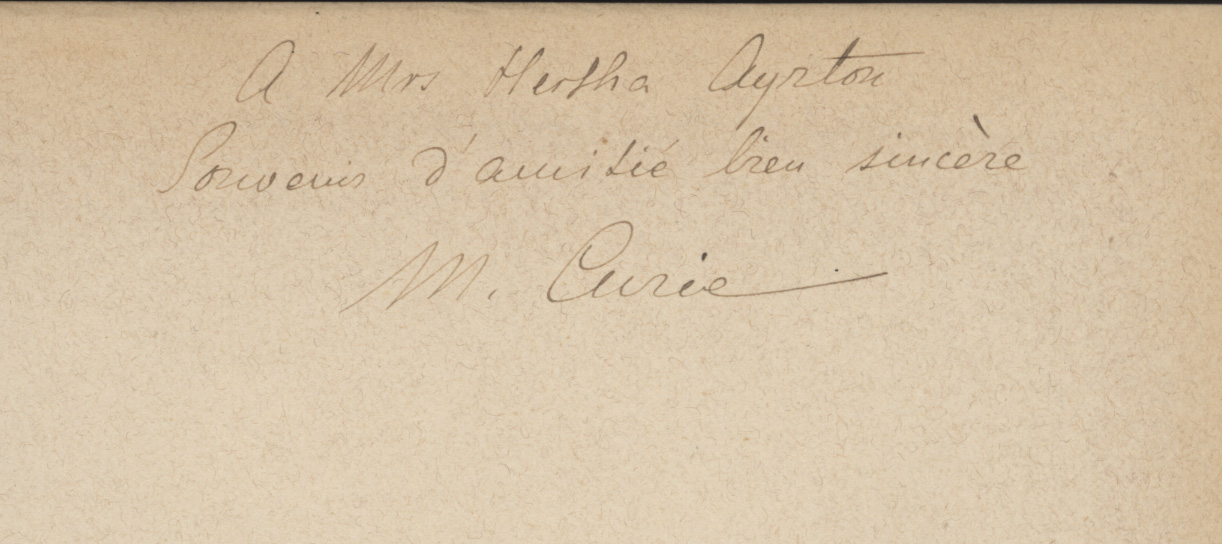
She was rescued by her close friend Hertha Ayrton, the first female member of London’s Institution of Electrical Engineers, who whisked her off for the summer to a seaside cottage on the edge of the New Forest. After travelling incognito under her maiden name – Skłodowska – Curie settled down for a couple of months with her two daughters, warmly welcomed into a group of Ayrton’s family and friends. For all the adults in the party, it was a time to relax, recuperate and enjoy the various children who accompanied them.
Visit to England
The planning for Curie’s trip had started many months earlier, when Ayrton was delivering a scientific paper in Paris and had seized the opportunity to visit Curie. Worried about her friend’s health, she repeatedly urged Curie to take refuge in England:
“You will not need to come to London before going there. I will meet you at Dover, or whichever port you come to, and we will all travel together along the coast…In this way no one will know anything about your visit and if you come under another name you will be absolutely safe from intruding visitors.”
Curie had planned to bring along a Polish governess, but Ayrton persuaded her to hire an Englishwoman, Miss Maning – cheaper and better for the girls’ education, she thoughtfully explained. Ayrton herself undertook to tutor Irène, Curie’s elder daughter, in mathematics.
The holiday was a great success, and any preliminary awkwardnesses must have been eased by Ayrton’s fluent French. ‘I maintain a great affection for you,’ Curie once wrote, ‘because you are not one of those people with whom one becomes disillusioned.’ After this idyllic interlude was over, Curie spent an additional few days in Ayrton’s London house, and stayed there again the following year when she visited England for a conference; it was only the outbreak of war that stymied their plans to get together during the summer of 1914.
Meeting at the Royal Institution
The two women had first met in London nine years earlier, when Curie was invited to give a talk at the Royal Institution on her discovery of radium. Despite her eminence, Ayrton was officially present not as a distinguished scientist in her own right, but as the wife of William, a Fellow of the Royal Society. She soon discovered that Marie Curie would be joining her in the audience as they watched Pierre Curie up on the stage presenting the results of his wife’s research project. From personal experience, Ayrton knew what that could feel like. Only two years earlier, she had been forced to sit in silence at the Royal Society, listening quietly while a man read out the paper that she had written herself. As her Who’s Who entry explained, ‘being of the female sex, the conservative regulations obliged her to depute a man to demonstrate her original research work.’ Was that her own bitter comment?
When she saw Curie endure the same ordeal at the Royal Institution, Hertha Ayrton was furious. She invited the Curies to dinner, an occasion that Marie appreciated as ‘one of her happiest memories of their stay in London’. Over the following years, they corresponded regularly as well as visiting each other in Paris and London. Curie became so well-known at Ayrton’s house near Hyde Park that the servants could be relied on to deal with any mail addressed to her.
The influence of Pierre’s lone performance at the Royal Institution lingered for many years, as journalists perpetuated the wrong assumption that the discovery was his and relegated Marie to the role of assistant. ‘M. Pierre Curie was ably seconded by his wife,’ reported one magazine, while another resorted to purple prose, gushing ‘that he could not do without her…She fanned the sacred fire in him whenever she saw it dying out.’ The false attribution was reinforced still further when Vanity Fair carried a double cartoon of the couple in a series called ‘Men of the Day’: Pierre is holding up a test tube of radium chloride whose glow illuminates his exaggerated forehead as if he were a born genius, while Marie peers timidly from behind his shoulder.

Pierre Curie died suddenly in a horrific road accident a few years later, but when he was heralded in the English press as the discoverer of radium, Hertha Ayrton could keep quiet no longer. ‘Errors are notoriously hard to kill,’ she fumed to the Westminster Gazette, ‘but an error that ascribes to a man what was actually the work of a woman has more lives than a cat.’ Ayrton was only too familiar with being sidelined by having her own original work credited to her husband, even though – she reported – ‘he saw some of my experiments for the first time when I showed them in public.’
Scientific outsiders and pioneers
Both marginalised by the chauvinistic male community, Curie and Ayrton were scientific outsiders who turned to each other for support. Outwardly, the careers of these two women were vastly different: one of them is the most famous female scientist of all time, whereas until recently the other was consigned to the obscurity of a few scholarly papers. But when looked at from the inside, from their own viewpoints, many close parallels between the experiences of these two women emerge. As unique pioneers, they were alienated from their contemporaries but found solace in each other – two women who had undergone very similar setbacks, insults and triumphs.
Professionally, they both knew what it felt like to win prestigious prizes and be recognised internationally, yet at the same time to be excluded from professional organisations. Both of them were politically active, and both of them were deeply involved in introducing scientific inventions during the First World War. More privately, they both endured childhood poverty, the early loss of a parent, the premature death of a husband, the challenges of mothering two daughters. And in a sense, both of them had always been outsiders. Ayrton was Jewish at a time when antisemitism was rife in Britain, while Curie was a foreigner not only in France, but also as a child in Warsaw, which was under Russian occupation. Hardly surprising that they shared another characteristic – repeated bouts of depression.
During the long hours they spent together that summer in the English countryside, each seeking to provide emotional support for the other, they wondered about the future and reminisced about the past. There were so many similarities between their lives. Most obviously, since Poland was a subject so close to Curie’s heart, they must have discussed Ayrton’s own Polish background. She had Polish ancestors on both sides of her family; most recently, her father, Levi Marks, had fled to England as a young man, desperate to escape from Jewish persecution under the Tsarist regime.
As women in a predominantly masculine scientific world, the two friends Curie and Ayrton were outsiders throughout their professional careers. Forced to speak Russian at school, Curie was made to feel a stranger in her own country, as if she were an illegal resident constantly on the alert to avoid antagonising the authorities. She felt still more estranged when she lived in France, constantly yearning for Poland and the family she had left behind – but her father chastised her for attending Polish events, urging her to lie low and avoid being noticed. When Curie’s affair with Langevin was exposed, the gutter press excoriated her as a ‘Jewish whore’, but Ayrton really was Jewish. In a letter to her patron George Eliot asking for advice about securing a position as a resident governess, she confessed that she suffered from several ‘disadvantages’ – the term she chose for compiling a self-deprecating list: ‘1. Short hair. 2. Being a Jewess (I may add, a pretty Jewess). 3. A heterodox Jewess…’ Just as for Marie Curie, being a woman was not the only problem weighing Ayrton down and consolidating her outsider status.
Further reading
Discover more about Hertha Ayrton and the Royal Society on the Royal Society blog


Leave a Reply